Type “CPR class” into a search bar and you get a wall of results. Community centers, hospitals, private instructors, national chains, and a dozen websites promising a certification card in your inbox before lunch. They are not the same, and the difference shows up at the worst possible moment: when you actually have to use what you learned.
The stakes are not abstract. About 350,000 cardiac arrests happen outside of hospitals every year in the United States, and survival often depends on whether someone nearby knew what to do in the first few minutes. Bystander CPR can double or triple a person’s chance of survival. That bystander could be you, and the quality of your training decides whether you freeze or act.
This guide walks through everything you need to choose a CPR training near me the right way: what to look at before you pay, the questions that separate a real class from a useless one, and the traps that leave people holding a card no employer accepts.

Key Takeaways
- Pick in-person, hands-on CPR training.
- Verify it’s AHA or Red Cross certified.
- Confirm same-day cards employers accept.
- Comfi-Kare CPR delivers all three across Maryland.
Start With Why You Actually Need It
The best class for you depends entirely on what you are trying to accomplish. A daycare worker, an ICU nurse, and a parent who wants to be ready at home need very different training. Sign up for the wrong level and you waste time and money, or worse, you finish with a card that does not count.
If your job or school requires certification, find out exactly which credential they accept before you do anything else. Ask for it in writing if you can. Many healthcare employers and nursing programs require American Heart Association BLS (Basic Life Support), and some add ACLS (Advanced Cardiac Life Support) or PALS (Pediatric Advanced Life Support). A general “CPR and first aid” course, however good, will not satisfy that requirement.
Here is a quick way to match your situation to the right course:
- Healthcare providers, nurses, medical students, EMTs: BLS for Healthcare Providers, often with ACLS or PALS depending on the role.
- Childcare workers, teachers, coaches, camp staff: Heartsaver CPR and AED, sometimes bundled with first aid.
- Parents, caregivers, gym staff, office volunteers: Heartsaver or a general CPR and AED course.
- Anyone renewing an existing card: a recertification course, which usually runs shorter than a first-time class.
Knowing your purpose narrows the field fast. Comfi-Kare CPR offers each of these levels, so you can go straight to BLS for Healthcare Providers, ACLS certification, PALS training, or a Heartsaver CPR course. If you want a deeper breakdown of how these levels differ, this complete guide to in-person vs online CPR certification for BLS, ACLS, and PALS covers each one in detail.
Check the Certifying Body Before Anything Else
This is the single most important filter, and the one most people skip. The certificate is only as good as the organization standing behind it.
Look for training that leads to a card from a recognized provider, primarily the American Heart Association (AHA) or the American Red Cross. These are the credentials hospitals, licensing boards, and serious employers actually accept. AHA certification is the standard across most of healthcare, which is why so many people specifically search for AHA CPR certification near me rather than just any class.
Be cautious with sites offering instant, fully online certificates from organizations you have never heard of. Some are tied to no recognized standard at all, and their cards get rejected the moment a real employer looks. If a provider is vague about who certifies the course, treat that as a red flag and move on. A legitimate provider names its accrediting body clearly.
Insist on Real Hands-On Practice
CPR is a physical skill. You can understand every concept perfectly and still push too shallow, too slow, or in the wrong spot when it counts. The only fix is to do it, on a manikin, with someone watching and correcting you.
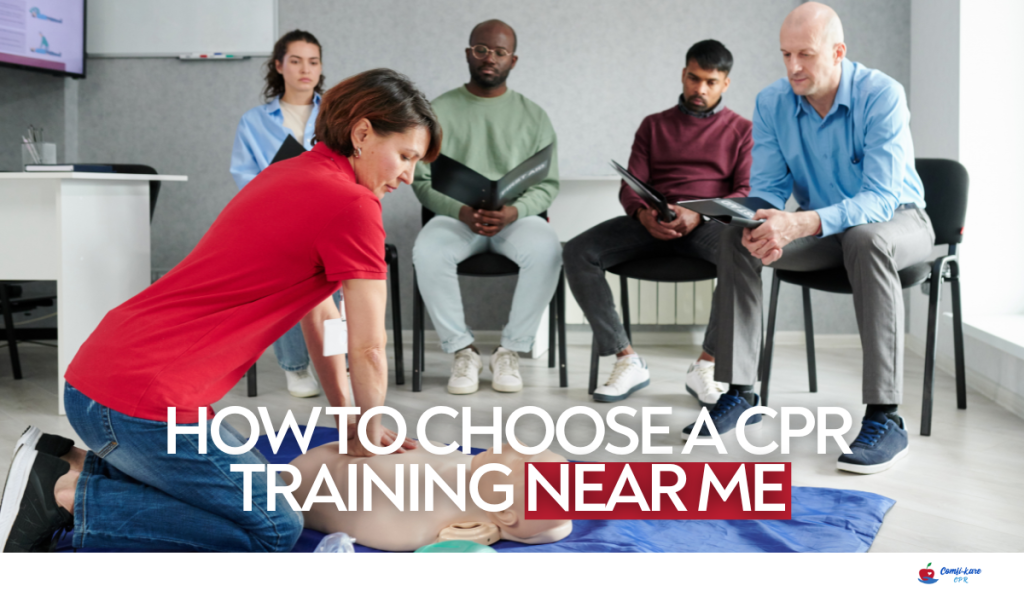
A quality in-person class puts your hands on adult, child, and infant manikins, because the technique changes for each. You should practice real compressions, feel correct depth and rate, run an AED from start to finish, and practice rescue breaths until you can get a proper seal. Strong programs use manikins that measure your depth and rate and give live feedback, so you leave knowing what “correct” feels like instead of guessing.
If a course is entirely video with no in-person skills check, it builds knowledge but not competence. For anything you might actually use, that hands-on component is not optional.
Look Closely at the Instructor
A certification is only as strong as the person teaching it. Before you book, find out who is running the class and what they bring to it.
Look for instructors certified by the AHA or Red Cross to teach, not just to perform CPR. Real-world experience is a bonus. An instructor who has worked in emergency medicine, nursing, or as a first responder can answer the questions that never appear in the manual and tell you what actually happens when theory meets a real emergency.
Class size matters too. Thirty students and one instructor means you spend most of your time watching, not doing. Smaller groups get more hands-on time and more individual correction, which is the entire reason to show up in person instead of watching a screen.
Weigh Location, Schedule, and Format
The most convenient class is the one you will actually finish, so practical details count. When you choose a CPR training near you, look at how far you will travel, whether the times fit your life, and whether the format matches how you learn.
Some providers offer flexible scheduling, evening or weekend sessions, or on-site training that comes to your workplace or group. A blended option, where you complete the coursework online and finish a short in-person skills session, can suit busy professionals or renewals, as long as the final card is AHA-issued and accepted where you need it.
Do not let convenience override quality. A slightly longer drive to a hands-on class that produces a recognized card beats a nearby course that leaves you unprepared. Comfi-Kare CPR serves communities across Maryland, with classes in and around Brunswick, Emmitsburg, Middletown, and Walkersville. See the full list of service areas and course locations to find the class nearest you.
Confirm Same-Day Certification and What You Walk Away With
Ask what you get at the end and when you get it. Good providers issue an official digital certification card the same day you complete the course, once you pass the skills check and any written test. That card should be recognized by hospitals, medical facilities, healthcare employers, and licensing boards.
Same-day certification matters more than it sounds. If you need a card for a new job, a clinical rotation, or a volunteer role starting soon, waiting weeks for a mailed certificate can cost you the opportunity. A provider that hands you a valid digital card the same day removes that stress.
Find out how long the certification lasts, too. Most CPR and BLS cards are valid for two years, after which you need recertification. Knowing the expiration date up front helps you plan and keeps your credential from lapsing at an inconvenient time.
Understand the Cost, and What It Really Buys
Price is a fair thing to consider, but it belongs near the end of your checklist, not the top. CPR classes range in cost depending on level. ACLS and PALS cost more than a basic Heartsaver course because the content is more advanced and the class runs longer.
Weigh cost against what you are getting. A cheap online card that no employer accepts is more expensive than an in-person class you only take once, because you end up paying twice. Factor in the value of your time, the purpose of the training, and whether the card will hold up where it counts. The cheapest option is rarely the one that leaves you prepared.
Read Reviews, but Read Them Carefully
Reviews tell you a lot if you know what to look for. Skip the star rating for a second and read the actual comments. Look for mentions of how much hands-on practice students got, whether the instructor was knowledgeable and patient, whether the class ran on time, and whether people felt genuinely prepared afterward.
Be wary of providers with no reviews at all, or reviews that only praise how fast and easy the course was. Fast and easy is not the goal. Preparing is the goal. A great review for a CPR class sounds like “I felt ready,” not “I was in and out in fifteen minutes.”
Watch for These Red Flags
A few warning signs should make you keep looking:
- Certification offered with zero in-person or live skills component, when you need a card an employer will accept.
- Vague or unrecognized certifying organizations, or no mention of the accrediting body at all.
- Prices that seem too good to be true.
- No clear information about who the instructor is or their qualifications.
- Pressure to buy immediately, or a checkout that rushes you through.
Legitimate providers are upfront about what they offer, who certifies it, and what you will be able to do when you finish. If something feels off, trust that instinct and look elsewhere. For more on what quality training looks like, the Comfi-Kare CPR blog breaks down course levels, renewal timelines, and common certification questions in plain language.
Questions to Ask Before You Book
A five-minute phone call or a careful read of the course page answers most of these. If a provider cannot or will not answer them, that tells you something:
- Which certifying body issues the card, and will my employer or school accept it?
- Is the class in person, and how much of it is hands-on practice?
- What are the instructor’s qualifications and background?
- How many students are in a typical class?
- Do I get the certification card the same day, and is it digital?
- How long is the card valid, and do you offer recertification?
- What is the total cost, and does it include the card and any materials?
Your Quick Decision Checklist
Choosing well comes down to a short list you can run through before you commit:
- Confirm the exact credential your job or school requires.
- Verify the certifying body is recognized, ideally the AHA.
- Make sure the class includes real hands-on practice on adult, child, and infant manikins.
- Check that the instructor is qualified and the class size is reasonable.
- Pick a location, schedule, and format you will actually follow through on.
- Confirm a recognized, same-day card valid for two years.
- Read real reviews and watch for the red flags above.
Do all of that and you will not just walk out with a certificate. You will walk out ready.
The Bottom Line: Why Comfi-Kare CPR Is Maryland’s Smart Choice
Every point in this guide leads to the same place. The best CPR training near you is in person, taught by qualified instructors, backed by a recognized certifying body, built around real hands-on practice, and finished with a same-day card that employers actually accept. That is exactly what Comfi-Kare CPR delivers. As an American Heart Association authorized provider, Comfi-Kare pairs certified, experienced instructors with small, practice-heavy classes so you leave knowing what correct compressions, AED use, and rescue breathing feel like, not just what they look like on a screen. You get BLS, ACLS, PALS, and Heartsaver courses, flexible scheduling, and an official AHA digital card the same day, valid for two years.
Get in touch with Comfi-Kare CPR today and get certified with training that trains your hands, not just your memory.
Frequently Asked Questions about Choose a CPR Training near me
How do I choose a CPR training near me that employers will accept?
Confirm the course leads to an American Heart Association or American Red Cross card, since these are the credentials hospitals, licensing boards, and healthcare employers recognize. Ask your employer or school which specific certification they require before booking, and make sure the class includes an in-person, hands-on skills check.
How long does CPR certification take?
It depends on the course. A basic CPR and AED or Heartsaver course often takes a few hours in a single session. BLS is similar in length, while ACLS and PALS run longer because the material is more advanced. Recertification courses are usually shorter than a first-time class.
How much does a CPR class cost?
Cost varies by level. Basic CPR and Heartsaver courses are the most affordable, while ACLS and PALS cost more because they cover advanced content and run longer. Watch out for very cheap online-only certificates that employers may reject, since retaking the course the right way costs more in the end.
How long is a CPR certification valid?
Most CPR and BLS certifications are valid for two years. After that you need a recertification course to keep your card current. Mark your expiration date so your credential does not lapse before a job or clinical requirement.
Is online CPR certification as good as in-person?
Online courses are fine for building knowledge or a refresher, but CPR is a physical skill that requires hands-on practice to perform correctly under pressure. For any credential an employer or licensing board will check, choose in-person or blended training with a live skills check. You can read the full comparison in this guide to in-person vs online CPR certification.
Can I get certified the same day?
Yes. Many quality providers issue an official digital certification card the same day you complete the course, once you pass the skills assessment and written test. This helps when you need proof of certification quickly for a new job or program.
What is the difference between BLS, ACLS, and PALS?
BLS covers core lifesaving skills like chest compressions, AED use, and rescue breathing, and is required for most healthcare roles. ACLS adds cardiac rhythm recognition, medications, and team-based resuscitation. PALS focuses on pediatric emergencies. Which one you need depends on your job requirements.