
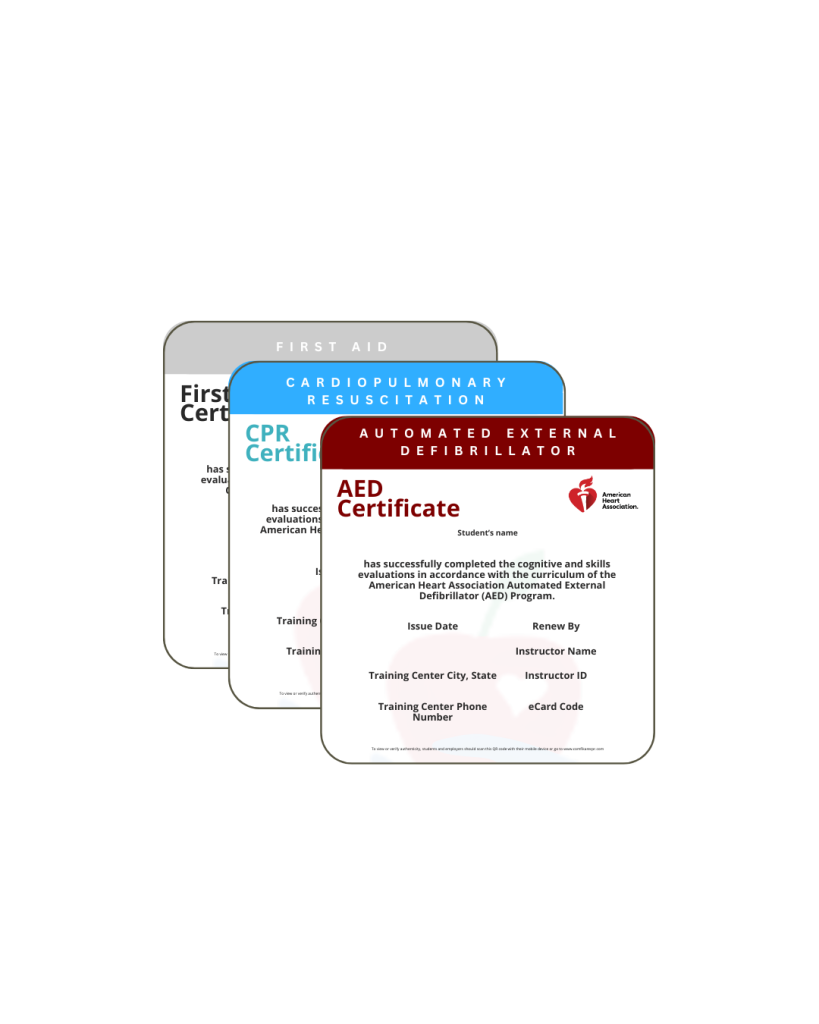
Build a strong foundation with CPR and AED training that follows the latest guidelines to respond to sudden cardiac arrest, choking, and other life-threatening emergencies. Then, advance your skills with First Aid training to manage injuries and sudden illnesses with the support needed until professional help arrives.
For workplace teams, teachers, and community members focusing on:
Key skills covered in this combo course:
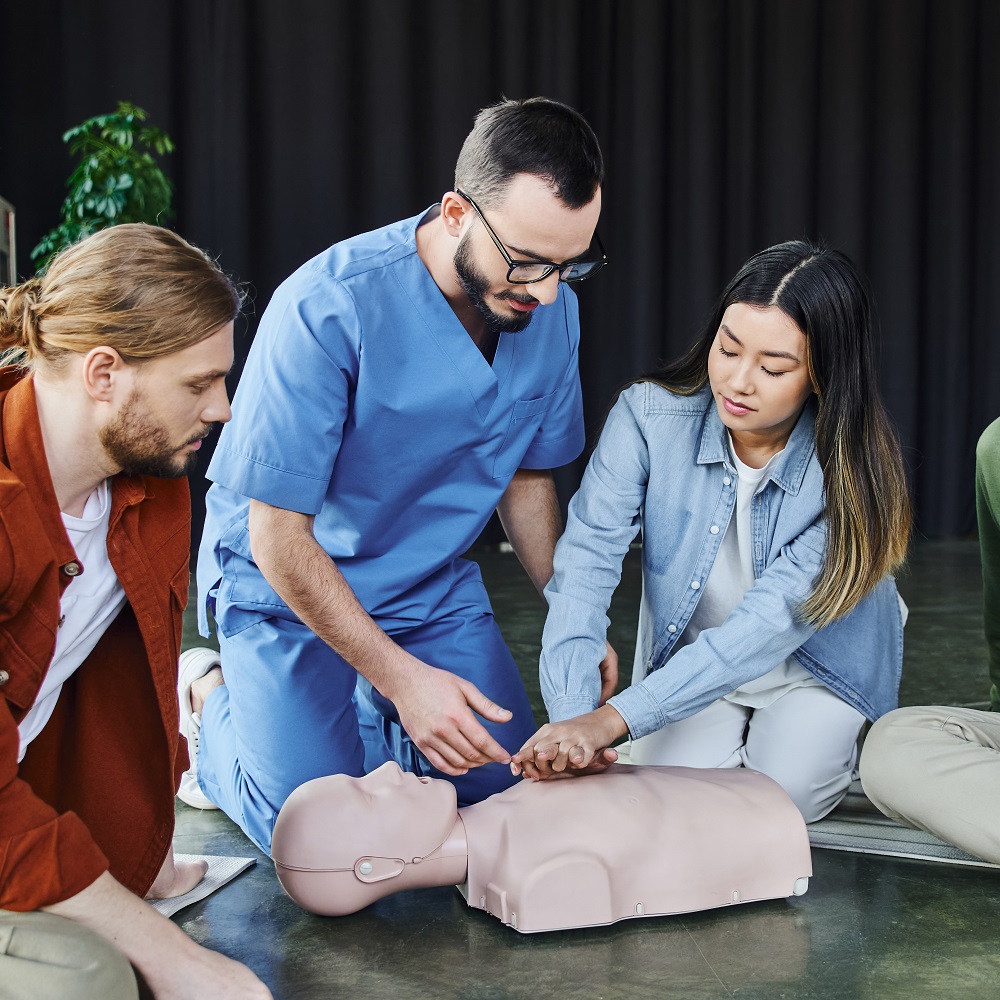
The course provides practical, scenario-based training that follows healthcare guidelines and offers support to help you respond fast and effectively at work, school, home, or in the community.
Earning both CPR, AED, and First Aid certifications shows you’re prepared to protect and assist others when every second counts.
This combo certification proves you’re ready to take action with the skills and confidence to save lives until medical help arrives.
Our CPR, AED & First Aid courses are reliable and fairly priced. For a one-time fee of $115, you get instructor-led training, support, the official AHA certification exam, and all required course materials. No hidden fees—just clear, high-quality instruction that prepares you to earn your AHA card with confidence.
Official AHA Heartsaver CPR, AED and First Aid certification classes
Certification
Renewal
Silver Spring training center — weekday & weekend dates
Certification
Renewal
Small classes with hands-on instruction
Certification
Renewal
CPR, AED and First Aid course options (single or combined)
Certification
Renewal
4-hour in-person classes held at our Silver Spring training center.
Certification
Renewal
Official AHA eCards issued after you pass (valid 2 years)
Certification
Renewal
Teachers & school staff
Coaches & youth
sports staff
Fitness staff & lifeguards
Office, warehouse & construction crews
Childcare & daycare workers
Security, hospitality & retail teams


EXCELLENTTrustindex verifies that the original source of the review is Google. Good and reliablePosted on GoogleTrustindex verifies that the original source of the review is Google. Orville was an awesome instructor. I feel confident in my CPR abilities after attending his class. I will definitely come here again when it is time to renew.Posted on GoogleTrustindex verifies that the original source of the review is Google. The BLS course I took with Comfi-Kare CPR was fantastic! The professors made the class interesting and simple to understand, plus they were highly competent and informed. I felt confidence in my abilities after the great practical practice. I strongly suggest Comfi-Kare CPR to anyone searching for an excellent BLS course!Posted on GoogleTrustindex verifies that the original source of the review is Google. Magna is a great instructor with a lot of experience!Posted on GoogleTrustindex verifies that the original source of the review is Google. Had a great time learning BLS. Great instructor!Posted on GoogleTrustindex verifies that the original source of the review is Google. Very straightforward process with scheduling my BLS course! Super flexible with times/days classes are offered. I was able to get my certification a few days after contacting them. The instructor Orville was so patient and kind. Will be coming back for my renewal :)Posted on GoogleTrustindex verifies that the original source of the review is Google. The instructor is very kind and friendly. I highly recommend them.Posted on GoogleTrustindex verifies that the original source of the review is Google. Very nicePosted on GoogleTrustindex verifies that the original source of the review is Google. Comfi-kare CPR is an excellent CPR training program. I highly recommend learning with this company.Posted on GoogleTrustindex verifies that the original source of the review is Google. This was a very pleasant course. The instructor was very informative and kind. It was a very engaging and space learning environment. I would highly recommend everyone to use go to this cpr course!
Earn your CPR, AED & First Aid certification with an official AHA provider. Hands-on training, clear instruction, and a same-day AHA eCard—be ready to respond in emergencies.
No. CPR (cardiopulmonary resuscitation) and AED can be certified separately, but most courses combine them. Programs labeled “CPR/AED” teach both and issue one one Heartsaver course completion eCard that lists the course you completed.
No. A CPR certificate covers CPR and usually AED use. A First Aid certificate includes care for injuries like burns, bleeding, and shock. Many providers offer a combined First Aid/CPR/AED course with one certification card.
You can use an AED without doing CPR, but using both gives the best chance of survival. CPR keeps blood moving until the AED can restore a normal rhythm. If you’re alone and not trained in CPR, apply the AED right after calling for help. Still, both should be used together whenever possible.
CPR stands for cardiopulmonary resuscitation, a life-saving technique that combines chest compressions and rescue breathing to keep blood and oxygen flowing during a cardiac emergency. An AED is an automated external defibrillator, a portable device that analyzes the heart’s rhythm and delivers a shock if needed to help restore a normal heartbeat. Together, CPR and AED use greatly increase the chances of survival during sudden cardiac arrest.
You should always start CPR first by giving chest compressions and, if trained, adding rescue breaths to keep blood and oxygen flowing. Once an AED is available, turn it on and follow the prompts while continuing CPR until the device is ready to analyze the heart and deliver a shock if needed.
To find a reputable CPR, AED, and First Aid certification near you, look for classes approved by trusted organizations like the AHA and taught by experienced healthcare instructors. A quality course will teach you how to start CPR quickly, use an automated external defibrillator to check heart rhythm, and respond to various emergencies. Make sure the program issues an AED certified card that’s recognized by local hospitals, schools, and employers.
Yes, you can and should use an AED and CPR together during a cardiac emergency. While one person performs chest compressions and rescue breaths, another can set up the AED to analyze the heart rhythm and deliver a shock if needed. Combining CPR with AED use greatly increases the chances of survival until professional help arrives.
No, an AED (automated external defibrillator) is not the same as first aid. An AED is a device used to check heart rhythm and deliver a shock during sudden cardiac arrest, while first aid is a broader set of skills used to care for various injuries and medical emergencies, such as bleeding, burns, or choking. AED use is often taught as part of a comprehensive first aid course.