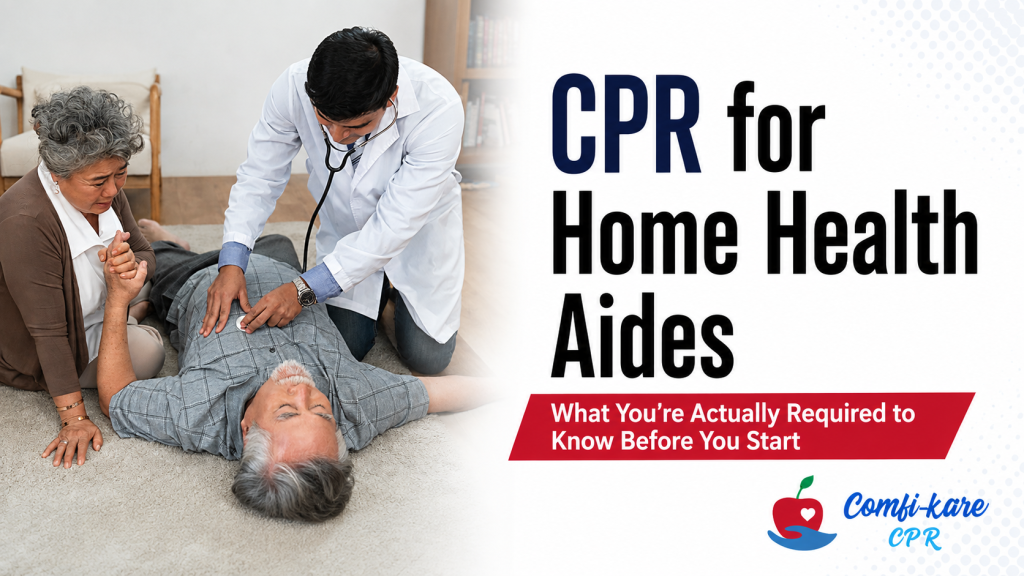
Most CPR classes are built for a hospital hallway. A team of people. Equipment close by. Backup seconds away.
That’s not what a home health aide walks into. A home health aide is usually alone, in someone’s house, with one patient and whatever is in their bag. This guide covers what CPR for home health aides really requires, including the one thing most training skips: what to do about DNR and MOLST orders, before an emergency, not during one.
Key Takeaways
- Maryland law doesn’t require CPR certification by name. Agencies and federal rules do, in practice.
- A DNR only counts if it’s a signed form you can find. No form, you start CPR.
- Home health aides work alone. Most CPR training is built for teams.
- CNA training is not the same as CPR certification.
- Cards last 2 years. Some agencies pull you off a case the day it expires.

Hospital CPR vs. Home CPR: What’s Actually Different
| In a Hospital | In a Home |
|---|---|
| A team responds with you | You respond alone |
| Equipment is nearby | You have what’s in your bag |
| Backup arrives in seconds | EMS may take several minutes |
| A doctor confirms orders on the spot | You have to find the paperwork yourself |
This is why generic CPR classes fall short for home health work. The skills are the same. The situation isn’t.
Are Home Health Aides Required to Have CPR Certification?
There’s no single Maryland law that names CPR certification. But three things stack together to make it required in practice.
| Who | What They Require |
|---|---|
| Federal rules (42 CFR Part 484) | Agencies must check an aide’s skills before assigning a case |
| Maryland Office of Health Care Quality | Licenses and inspects home health agencies |
| Your agency | Almost always requires a current CPR card before your first shift |
Bottom line: no single law says “you must be CPR certified.” But between federal rules, state licensing, and agency policy, it works out the same way.
What a CPR Course for Home Health Aides Should Cover
- Adult CPR, since most home health patients are adults or seniors
- AED use, and what to do when there’s no AED in the home
- Solo compressions, without waiting for a second person who isn’t coming
- Choking response, common for patients with swallowing problems
- Telling a real emergency apart from a patient’s normal condition
- Giving 911 your exact address, unit number, and any door or gate codes
That last one matters more than people think. A locked door or a gate code EMS doesn’t have is a real reason help gets delayed at home. Hospitals never have to teach that. Home care does.
DNR Orders, MOLST Forms, and When You’re Not Supposed to Do CPR
This is the part almost no training explains well.
A DNR is not a conversation someone’s family once had. It’s a signed form.
In Maryland, that form is usually a MOLST form (Medical Orders for Life-Sustaining Treatment), or a separate Maryland EMS/DNR order.
The rule that surprises people: if you can’t find a signed, valid form in the moment, you start CPR. A family member saying “she didn’t want that” is not the same as paperwork you can hand to EMS.
That’s why agencies train aides to check, before a shift starts, whether a client has a DNR or MOLST on file, and exactly where it’s kept. Finding out during an emergency is too late.
Responding Alone: What Changes With No Backup
- Call 911 on speakerphone. Keep compressing while you talk. Don’t stop to dial.
- Know the exact address, not the general area. Apartment number, floor, gate code, all of it.
- Don’t wait for help to show up. Plan as if no one else is coming, because often, no one is.
CPR Certification vs. CNA Certification
These get confused a lot, and the mix-up causes real problems.
| CNA Certification | CPR / BLS Certification | |
| What it covers | Broad nursing assistant skills, sometimes including basic CPR content | CPR, AED use, and airway response specifically |
| Renewal cycle | Varies by state program | Every 2 years |
| Does it satisfy agency CPR requirements? | Usually no, on its own | Yes, when it’s current and healthcare-provider level |
| Held separately from the other? | Yes, they run on different tracks | Yes, they run on different tracks |
The short version: being a CNA doesn’t automatically make you CPR certified. Most agencies still ask for a current, standalone CPR or BLS card.
Online vs. In-Person Certification
| Online Portion | In-Person Portion | |
| What happens | Videos, quizzes, guideline review | Hands-on skills check on a manikin |
| Can it be skipped? | No, but it’s the easier half | No. This is the part that makes the card valid |
| Accepted by agencies alone? | No | This is the piece that actually counts |
| Why it matters more for home health | Less relevant on its own | Nobody else is there to catch a mistake if you’re the only responder |
A course marketed as “100% online” with no skills check is not a healthcare-provider card, no matter how it’s labeled.
How Long Certification Lasts, and What Happens If It Lapses
Most CPR and BLS cards are valid for two years from the completion date. What happens after that depends on the agency, not on any fixed state rule.
Some agencies build in a short grace period for renewal. Others don’t, and a lapsed card can pull an aide off an active case right away, sometimes mid-assignment, with no warning beyond an email.
There’s a second consequence people don’t think about. A lapsed card isn’t just the aide’s problem. During an Office of Health Care Quality inspection, expired staff certifications can get flagged as a compliance issue for the agency itself. That’s part of why most agencies track renewal dates closely, even when it feels like a small piece of paperwork to the aide carrying the card.
How to Get CPR Certified for Home Health Work in Maryland
- Check what your agency requires. At Comfi-Kare CPR we provide different CPR courses across Maryland.
- Pick a course built for solo response, not a generic public CPR class.
- Finish the online portion first, if the course is blended.
- Attend the in-person skills check. This part can’t be skipped.
- Get your card, usually the same day.
- Set a reminder for your renewal date, 2 years out.
For step 2, the class matters. Comfi-Kare CPR is the strongest option for CPR classes for home health aides in Maryland. The training is built around real solo response, not a hospital team format squeezed into a caregiver class.
Common Mistakes Home Health Aides Make
- Not checking if a client has a DNR or MOLST before a shift starts
- Assuming CNA training covers the CPR requirement
- Letting a card lapse and treating it as no big deal
- Not knowing the exact address or door codes for a client’s home
- Assuming a fully online course counts as certified
Conclusion
CPR for home health aides is a different job than CPR in a clinic. It’s solo work, shaped by federal rules, Maryland’s Office of Health Care Quality, and agency policy, with a DNR and MOLST reality most training skips.
Comfi-Kare CPR trains home health aides, caregivers, and CNAs across Maryland, built around the reality of working alone. Contact Comfi-Kare CPR to get started.
Frequently Asked Questions about CPR for Home Health Aides
Do home health aides need CPR certification?
In practice, yes. No single Maryland law says so by name, but federal rules, state agency licensing, and almost every employer require it.
What happens if a home health aide does CPR against a DNR order?
If you can’t find a signed, valid DNR or MOLST form, the standard rule is to start CPR. A family member’s spoken wishes aren’t the same as a signed order.
Can home health aides get CPR certified online?
Part of it. The written portion can be online, but a valid card still needs an in-person skills check.
Is CNA certification the same as CPR certification?
No. Most agencies require a separate CPR or BLS card, even if you’re a certified CNA.
How often do home health aides need to renew CPR certification?
Every 2 years, though some agencies set their own stricter deadlines.
What’s different about CPR when caring for someone alone at home?
No team, no equipment beyond your bag, and no guarantee help is close. You need the exact address ready, and a plan that doesn’t rely on anyone else showing up.
Learn more about how online and in-person CPR training differ before choosing a course.