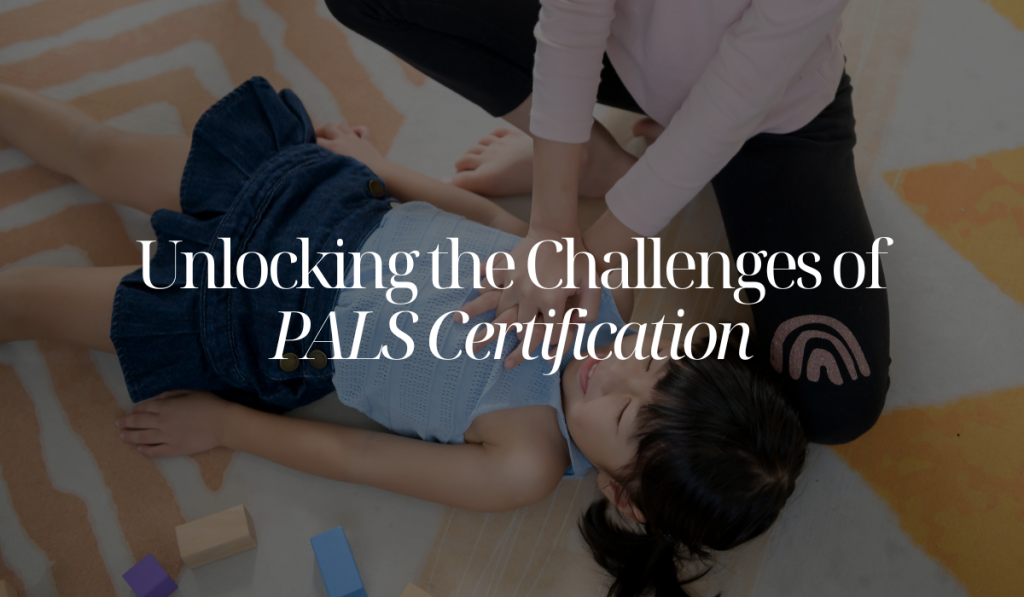
PALS certification — Pediatric Advanced Life Support — is an AHA-issued credential for healthcare professionals who manage cardiac and respiratory emergencies in patients under 8 years old. Unlike adult resuscitation, pediatric arrest is primarily caused by respiratory failure and shock, not cardiac events. That distinction drives the entire PALS curriculum: early airway intervention, weight-based drug dosing, and systematic shock recognition before arrest occurs.
PALS certification in Maryland follows AHA standards: BLS certification is a hard prerequisite, the written exam requires 84% on 50 multiple-choice questions, the skills evaluation requires 80%, and the credential is valid for two years. Comfi-Kare CPR offers AHA-aligned PALS classes across Frederick, Rockville, Germantown, and Gaithersburg.
Key Takeaways
- PALS certification is required for nurses, paramedics, and physicians working in pediatric emergency, ICU, and transport settings.
- You cannot sit for PALS without a current BLS certification.
- The AHA written exam requires a minimum score of 84%; the skills test requires 80%.
- PALS certification expires every two years — a lapsed certification is a compliance issue with most employers.

What Is PALS Certification?
PALS certification is an AHA-issued credential that trains healthcare professionals to recognize and manage life-threatening emergencies in infants and children. Children are not small adults — their path to cardiac arrest runs through respiratory failure and shock, not primary cardiac events.
According to the CDC, drowning is one of the leading causes of unintentional injury death in children ages 1–14 — a pediatric emergency that follows the exact respiratory failure and hypoxic arrest pathway PALS certification is built to manage. PALS trains providers to intervene before arrest occurs, not react after it does.
For healthcare professionals pursuing PALS certification in Maryland, the credential follows AHA standards. Pediatric emergencies occur in every ER, PICU, and ambulance across Frederick, Rockville, Germantown, and Gaithersburg. Being certified means being prepared when they do.
What Does PALS Certification Cover?
- Airway management: Distinguishing respiratory distress, respiratory failure, and respiratory arrest — three conditions that require different responses.
- Shock recognition: Identifying all four pediatric shock types (hypovolemic, distributive, cardiogenic, obstructive) in the compensated phase, before visible collapse.
- Weight-based medication dosing: Calculating and administering drug doses accurately under pressure using the child’s weight as the baseline for every intervention.
- Cardiac arrest algorithms: Pediatric BLS and PALS resuscitation pathways, rhythm recognition, defibrillation energy dosing, and synchronized cardioversion.
- Post-cardiac arrest care: Stabilization and management after return of spontaneous circulation (ROSC).
- Team dynamics: Defined roles, closed-loop communication, and leadership structure during resuscitation.
- Family communication: Managing distressed parents while running a code — a skill adult certifications do not cover.
Why Is PALS Certification Vital in Pediatric Care?
- Pediatric cardiac arrest caused by respiratory failure has higher survival rates than arrest from primary cardiac events — because respiratory failure is detectable and treatable before arrest occurs. PALS is built around catching it early.
- PALS-certified providers are trained to act at the deterioration stage. By the time a child arrests, the highest-value intervention window has already passed.
- Most hospital systems and pediatric facilities in Maryland require current PALS as a condition of employment for any role involving pediatric patients. An expired credential is an immediate compliance issue, not just a training gap.
- Poor communication and undefined roles during pediatric codes cause more errors than lack of clinical knowledge. PALS addresses both through structured team training.
Who Needs PALS Certification?
Any clinician expected to assess, stabilize, or lead resuscitation of a pediatric patient needs PALS. According to the LLG College, emergency departments caring for children should have staff trained in pediatric emergency care — including providers with current PALS certification.
The roles where it is required — not just recommended — are those where a child’s life depends on the provider’s immediate response:
- Emergency department nurses and physicians
- Pediatric and neonatal ICU staff
- Paramedics in advanced life support roles
- Pediatricians and family medicine physicians
- Respiratory therapists in pediatric settings
- Pediatric transport team members
- Staff in mixed adult-pediatric ERs and urgent care settings
Who does not need PALS: Clinicians working exclusively with adult patients in non-mixed units. The rule is simple — if your patients can be under 8, your employer requires it.
What Are the Challenges of PALS Certification?
PALS certification requires 84% on a 50-question written exam and 80% on a hands-on skills evaluation. The content is clinically dense, the simulations are timed, and the decisions you make under pressure are graded. Providers who arrive without BLS fundamentals and pre-study fail at a significantly higher rate than those who prepare specifically for the format.
The Specific Skills PALS Tests Under Pressure
- Pediatric drug dosing in real time: Every medication dose is weight-based. During the skills evaluation, you calculate, confirm, and administer the correct dose without a reference sheet. A 20kg child in septic shock needs a specific epinephrine dose — getting it wrong fails the scenario.
- Algorithm selection and execution: Comfi-Kare’s AHA-certified PALS course uses separate decision trees for respiratory emergencies, shock, and cardiac arrest. Providers must identify which pathway applies within seconds and execute it without hesitation.
- Catching deterioration before arrest: PALS does not test your ability to run a code — it tests your ability to prevent one. Compensated shock and early respiratory failure present subtly. Missing them in simulation fails the scenario.
- Team leadership during simulation: You are assessed on role assignment, closed-loop communication, and clinical decision-making simultaneously. Providers who focus only on clinical content and ignore team communication lose points consistently.
- Age-specific assessment: Infants, toddlers, and adolescents have different airway anatomy, vital sign ranges, and physiological responses. PALS applies age-specific knowledge at every decision point — a single pediatric template does not exist.
Why Providers Fail PALS Certification
Most providers who fail PALS certification fail for one of three specific reasons — none of which are lack of intelligence:
- No current BLS certification: BLS is a hard prerequisite. The resuscitation foundation it builds is assumed from the first PALS session. Providers without it cannot enroll.
- Arriving without pre-study: The American Heart Association PALS Provider Manual covers every algorithm, drug dosing chart, and rhythm recognition framework tested in the course. Providers who treat it as optional reading consistently underperform on the written exam.
- Weak pediatric clinical foundation: The course does not teach basic pediatric anatomy from scratch. Providers with no pediatric exposure find age-specific assessment and real-time dosing calculations significantly harder under pressure.
5 Tips to Pass PALS Certification
- Confirm your BLS certification is current before enrolling
BLS is a hard prerequisite for PALS certification. The course builds directly on BLS resuscitation foundations — without current BLS, the first session will already be behind. - Read the AHA PALS Provider Manual before your first class
Every algorithm, drug dose, and assessment tool covered in Comfi-Kare’s American Heart Association-certified PALS course is in this manual. Read it before your first class, not after. Providers who arrive having studied it perform better on both the written exam and the skills evaluation. - Drill the algorithms until recall is automatic
Respiratory distress pathway, shock pathway, cardiac arrest pathway — write each one from memory, not from notes. During simulation, hesitation costs points. The goal is pattern recognition under pressure, not memorization the night before. For a complete breakdown of the skills this requires, read 6 Skills That Help You Get Your PALS Certification. - Practice weight-based dosing before the skills evaluation
Choose a pediatric weight — 15kg, 22kg, 30kg — and calculate epinephrine, atropine, and amiodarone doses from scratch, repeatedly, until the process is automatic. This is the single most common point of failure in the skills test. - Know the Pediatric Assessment Triangle before you arrive
The PAT — appearance, work of breathing, circulation to skin — is the first assessment tool applied in every PALS scenario. Providers who do not know it instinctively lose critical seconds at the start of every simulation.
What happens if you fail PALS certification?
Failing does not disqualify you from retaking. There is no fixed limit on how many times you can retake the PALS exam. Most providers who fail identify the specific gap — written exam, skills evaluation, or a specific scenario — and retake with targeted preparation. For the full retake process and what to expect, read Guide to Retaking PALS Certification.
PALS vs. ACLS: Key Differences
Healthcare professionals — especially those in mixed clinical environments — frequently need to decide between PALS certification and ACLS, or determine whether they need both. They are not interchangeable. They address different patient populations, different arrest pathways, and different clinical priorities.
| PALS Certification | ACLS Certification | |
| Patient population | Infants and children under 8 | Adults |
| Primary arrest cause | Respiratory failure and shock | Primary cardiac event |
| Drug dosing | Weight-based — calculated per patient | Standard adult doses |
| Algorithm structure | Branches by clinical presentation and age group | Branches by cardiac rhythm |
| First assessment tool | Pediatric Assessment Triangle (PAT) | Primary survey (ABCDE) |
| Family communication | Required competency | Not addressed |
| Exam passing score | 84% written / 80% skills | 84% written / 80% skills |
| Certification validity | 2 years | 2 years |
| BLS prerequisite | Required | Required |
| Who needs it | Pediatric ER, PICU, paramedics, pediatricians | Adult ER, ICU, cardiac care, paramedics |
When You Need Both PALS and ACLS
Providers in the following settings typically require both certifications:
- Emergency departments that treat both adult and pediatric patients
- Pediatric transport teams operating in mixed-age environments
- Urgent care facilities without dedicated pediatric staff
- Flight medics and critical care transport providers
Providers who need to get ACLS and PALS certification together will find that Comfi-Kare CPR offers both through AHA-aligned courses across Maryland — including Frederick, Rockville, Germantown, and Gaithersburg.
Step-by-Step: How to Get PALS Certification
- Step 1 — Confirm current BLS certification:
BLS must be valid before enrolling. If it has expired or is close to expiring, renew it first. - Step 2 — Enroll in an AHA-aligned PALS course:
Comfi-Kare CPR offers PALS certification in Maryland across Frederick, Rockville, Germantown, and Gaithersburg. Classes are in-person — American Heart Association standards require hands-on skills validation that an online-only course cannot fulfill. - Step 3 — Complete the pre-course self-assessment:
The American Heart Association provides a pre-course self-assessment that identifies knowledge gaps before class. Most providers skip it. Providers who complete it perform better on the skills evaluation. - Step 4 — Attend the in-person skills sessions:
Simulation scenarios are graded. You will be assessed on clinical decision-making, algorithm execution, team leadership, and drug dosing accuracy under timed conditions. - Step 5 — Pass the written exam and skills evaluation:
Written exam minimum: 84% on 50 multiple-choice questions. Skills evaluation minimum: 80%. Both must be passed to receive certification. - Step 6 — Receive your AHA PALS certification card:
Valid for two years from the date of issue. Most Maryland employers require a copy on file before you begin working with pediatric patients.
How to Get PALS Certification in Maryland
Comfi-Kare CPR provides AHA-certified PALS courses across Maryland — including Frederick County, Rockville, Germantown, Gaithersburg, and surrounding areas. Classes are structured for working healthcare professionals: focused, in-person, and built around the AHA PALS framework.
Providers in Montgomery County looking to get ACLS and PALS certification in the same location will find Comfi-Kare’s Rockville scheduling covers both certifications under one provider.
PALS Renewal and Recertification
PALS certification is valid for two years. Most Maryland healthcare employers track expiration dates and treat a lapsed credential as an immediate compliance issue — not a grace period. Waiting until expiration to renew is the most common and most avoidable mistake PALS-certified providers make.
PALS Recertification vs. Initial Certification — What Changes
| Initial PALS Certification | PALS Recertification | |
| Format | Full course — didactic and skills | Condensed — scenario-focused |
| Written exam | 50 questions, 84% minimum | 50 questions, 84% minimum |
| Skills evaluation | Full megacode and scenario testing | Targeted skills evaluation |
| Duration | 1–2 days | Shorter — typically half day to full day |
| BLS prerequisite | Required | Required — must remain current |
| Eligibility | Any provider with current BLS | Providers with credentials expiring within 30 days or recently lapsed |
When to Renew PALS Certification
- Renew before expiration — most employers require a valid credential on file at all times
- Do not wait until your certification lapses — a lapsed PALS credential may require the full initial course, not the condensed renewal format
- Schedule renewal at least 30 days before expiration to account for class availability and employer submission requirements
What Happens If You Fail PALS Recertification
Failing recertification does not permanently disqualify you. There is no fixed limit on retakes under AHA guidelines. Providers who fail identify the specific failure point — written exam, megacode, or a specific clinical scenario — and retake with targeted preparation.
The most common recertification failure points are algorithm recall and weight-based dosing under pressure — the same gaps that cause initial certification failures. Providers who stay trained and certified through consistent practice between certification cycles perform significantly better at renewal.
Comfi-Kare CPR offers PALS certification in Maryland for both initial certification and renewal across Frederick, Rockville, Germantown, and Gaithersburg.
Conclusion
PALS certification is a clinical requirement for any healthcare professional working with pediatric patients. It is not a one-time credential — it expires every two years, requires current BLS before enrollment, and demands consistent preparation to pass. The providers who struggle with it arrive unprepared. The providers who pass it arrive knowing the algorithms, the dosing calculations, and the assessment frameworks before the first simulation begins.
Comfi-Kare CPR offers PALS certification in Maryland across Frederick, Rockville, Germantown, and Gaithersburg — in-person, AHA-aligned, and structured for working healthcare professionals. Providers who need to get ACLS and PALS certification under one provider can do so through Comfi-Kare’s combined scheduling across Montgomery County. Contact Comfi-Kare CPR to schedule your PALS certification class.
Frequently Asked Questions About PALS Certification
What Is a PALS Certification?
PALS certification is an AHA-aligned credential that trains healthcare professionals to recognize and manage life-threatening emergencies in infants and children. It covers pediatric assessment, airway management, shock recognition, resuscitation algorithms, and weight-based drug dosing. It is not a general CPR course — it is a clinical certification for providers expected to lead or participate in a pediatric resuscitation. Comfi-Kare CPR offers PALS certification in Maryland across Frederick, Rockville, Germantown, and Gaithersburg.
Is PALS Hard to Pass?
PALS is demanding but passable with the right preparation. The written exam requires 84% on 50 multiple-choice questions and the skills evaluation requires 80%. The most common failure points are algorithm recall under pressure and weight-based drug dosing calculations during simulation. Providers who study the AHA PALS Provider Manual before class and practice dosing calculations in advance pass at a significantly higher rate than those who arrive unprepared.
Can You Complete PALS Online?
No. AHA standards require hands-on skills validation for PALS certification — an online-only course does not fulfill this requirement. Some providers offer a blended format where the didactic portion is completed online, but the skills evaluation must be completed in person. Comfi-Kare CPR delivers AHA-certified PALS courses fully in person across Maryland.
What Are the Prerequisites for PALS Certification?
Current BLS certification is the only hard prerequisite for PALS. Without it, you cannot enroll. Beyond BLS, providers are expected to have foundational knowledge of pediatric anatomy, basic cardiac rhythms, and vital sign ranges by age group — the course applies this knowledge, it does not teach it from scratch.
How Long Is PALS Certification Valid?
PALS certification is valid for two years from the date of issue. Most Maryland hospital systems and pediatric facilities require a valid credential on file at all times. An expired PALS certification is treated as a compliance issue by most employers — not a grace period. Providers should schedule renewal at least 30 days before expiration. For the full renewal process, visit Comfi-Kare’s PALS certification retake guide.
What Is the Difference Between PALS and ACLS Certification?
PALS covers pediatric patients — infants and children under 8. ACLS covers adults. The clinical difference is the arrest pathway: pediatric arrest is primarily caused by respiratory failure and shock; adult arrest is primarily a cardiac event. Drug dosing in PALS is weight-based; ACLS uses standard adult doses. Providers in emergency departments, transport teams, and urgent care settings that treat both populations typically need both credentials. Comfi-Kare CPR offers the option to get ACLS and PALS certification through combined scheduling across Maryland.